August 10, 2024

 Home
Home
 Climate Change
Pakistan did not cause the climate crisis, yet it has become one of its most punishing case studies. The 2022 floods submerged a third of the country, displaced over 33 million people, and destroyed close to two million homes. Four years on, the water has receded from most districts, but the more serious damage to how women survive disaster has never been addressed. Pakistan's climate emergency response remains built for a generic victim who does not actually exist. Disasters are not gender-neutral, and neither is recovery.

Start with the numbers that rarely make it into policy briefings. During the 2022 floods, pregnant women in Sindh and Balochistan gave birth in open fields and roadside camps because mobile health units either did not exist or could not reach flood-cut villages in time. UN Population Fund estimates put the number of pregnant women affected by the floods at over 128,000, with thousands due to deliver within weeks of the disaster. Maternal health does not pause for a national emergency, but Pakistan's emergency infrastructure paused for maternal health. Relief camps were designed around shelter and food distribution, not around menstrual hygiene, prenatal care, or the basic privacy that allows women to seek help without being watched by male relief workers or strangers in a shared tent.
This is not an oversight. It is what happens when disaster planning is built without women in the room. Pakistan's National Disaster Management Authority and its provincial counterparts have historically operated with minimal gender expertise embedded at the decision-making level. Gender is treated as an add-on, a chapter appended to a policy document after the technical planning is finished, rather than a variable that shapes who survives, who gets fed first, and who returns to a functioning life once the cameras leave.
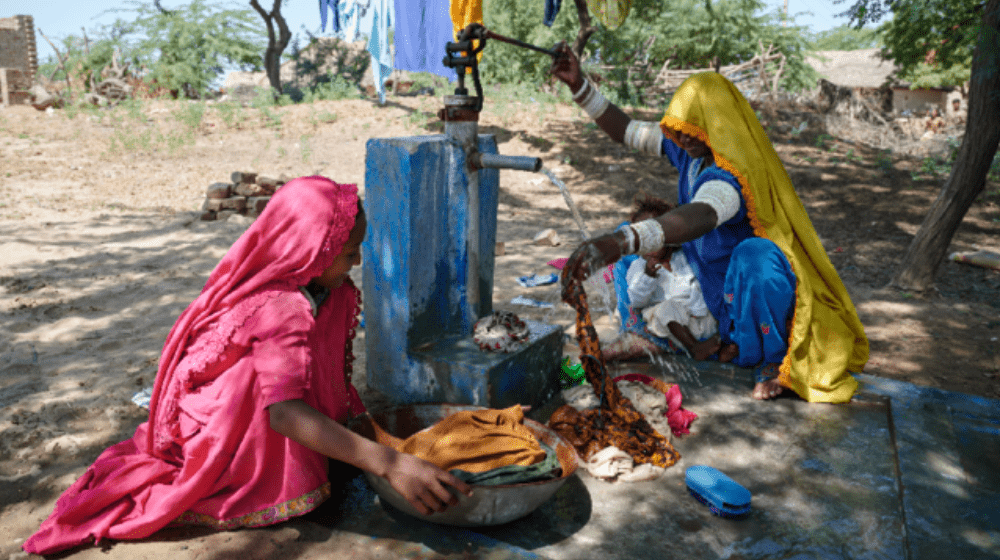
Displacement compounds this. Women in flood-affected rural Sindh, particularly from landless and sharecropping households, lost not just homes but the informal economic networks that gave them any leverage at all: kitchen gardens, livestock, small-scale embroidery work sold through local intermediaries. Men can migrate for labour after a disaster; women, often bound by mobility restrictions and childcare responsibilities, cannot follow the same path. The result is a widening gap where male household members send remittances from cities while women remain in flood-damaged villages, managing children, elderly relatives, and rebuilding, with no income, no land title in their name, and no seat at the village committees that decide how relief funds are distributed.
Gender-based violence spikes after every climate disaster in Pakistan, and yet this remains one of the least resourced parts of the humanitarian response. Overcrowded camps, loss of privacy, and the collapse of normal social protections create conditions where domestic violence increases and where women and girls face heightened risk of harassment and trafficking. Child marriage rates rise in flood-affected districts as families facing economic desperation see early marriage as a coping mechanism, a data pattern documented after both the 2010 and 2022 floods. These are not side effects of climate change. They are its direct, gendered outcomes, and they demand direct, gendered responses: safe spaces within camps, women-led distribution points, female first responders, and post-disaster cash transfers made directly to women rather than routed through male heads of household.
Some of this groundwork exists on paper. Pakistan's National Climate Change Policy references gender mainstreaming, and provincial disaster authorities have begun consulting gender specialists after sustained pressure from civil society and international donors. But intention without institutional weight changes little. What Pakistan needs is not another policy annex acknowledging that women are vulnerable. It needs gender expertise embedded at the point of emergency planning, before the next flood, not after it. It needs female enumerators collecting displacement data, because women will not disclose needs, injuries, or violence to male surveyors. It needs local women's organizations, the ones already doing this work in Sindh and southern Punjab with almost no funding, brought into formal coordination structures rather than treated as an afterthought once international NGOs arrive.
Pakistan sits at the sharp edge of a crisis it did almost nothing to create, ranked consistently among the countries most vulnerable to climate impacts despite contributing a fraction of a percent of global emissions. That injustice is well documented internationally. What receives far less attention is the injustice happening inside Pakistan's own borders, between men and women living through the same disaster with entirely different odds of survival, safety, and recovery. Climate finance conversations at COP summits will keep circling loss and damage, adaptation funding, and mitigation targets. All of that matters. But if the money that eventually arrives is spent rebuilding the same gender-blind emergency systems, Pakistan will have rebuilt its infrastructure and repeated its failure.
The next flood is not a hypothetical. It is a near-certainty given Pakistan's monsoon patterns and glacial melt trajectory. The question is whether the country's emergency response will still be designed for a version of the disaster victim that ignores half the population, or whether it will finally reckon with the reality that in Pakistan, climate change has a gender, and so far, women have been paying for it alone.


August 10, 2024
August 10, 2024

August 10, 2024
August 10, 2024


‘2’ Comments
Michael jordan
22 August, 2024Interactively visualize top-line internal or "organic" sources rather than top-line niche mark unleash 24/7 opportunities after high standards in process improvements. Uniquely deploy methodologies with reliable information.
Johon Alex
22 August, 2024Interactively visualize top-line internal or "organic" sources rather than top-line niche mark unleash 24/7 opportunities after high standards in process.
Leave A Comments